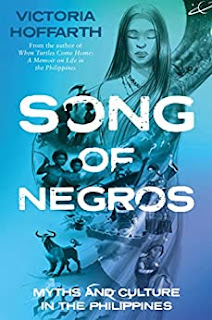

Stephanie Jane recenzis Song Of Negros de Victoria Howarth
A great addition to a fairytale library
3 steloj
Song Of Negros is an unusual book which explores a number of traditional folktales collected for elder community members on the island of Negros in the Philippines. As well as recounting the myths themselves, Victoria Hoffarth also connects them to the particular culture of this divided island and to the wider Philippine archipelago. She looks at the history and sociology of the people living there, especially the ways in which hundreds of years of colonial rule, by a series of occupiers, have altered Negros. Song Of Negros is a book in two parts which did make it feel disjointed to read although I could understand why this format might have been adopted. The first half comprises the retelling of fifteen myths with an explanation of how such tales are identified as fairytale, myth or legend. Hoffarth ends each with brief notes, several of whose ideas are picked up and discussed …
Song Of Negros is an unusual book which explores a number of traditional folktales collected for elder community members on the island of Negros in the Philippines. As well as recounting the myths themselves, Victoria Hoffarth also connects them to the particular culture of this divided island and to the wider Philippine archipelago. She looks at the history and sociology of the people living there, especially the ways in which hundreds of years of colonial rule, by a series of occupiers, have altered Negros. Song Of Negros is a book in two parts which did make it feel disjointed to read although I could understand why this format might have been adopted. The first half comprises the retelling of fifteen myths with an explanation of how such tales are identified as fairytale, myth or legend. Hoffarth ends each with brief notes, several of whose ideas are picked up and discussed more fully in a selection of sociological essays that make up Songs Of Negros' second half.
I particularly liked the way in which Hoffarth related each myth to the communal traits of Philippine people, especially the Negros populations. She asks to what extent these influential traditional stories shaped Negros culture or whether they actually just reflect characteristics which were already present. This reminded me of a Western fairytale examination I also read recently, Cinderella Didn't Live Happily Ever After by Anne Beall, which asked similar questions of Grimm's tales. In Song Of Negros, Hoffarth also shows how the Negros tales demonstrate a highly cooperative culture where priority is given to the success of the community. This contrasts strongly with my English culture where individual achievements are more greatly valued, often at the expense of the community, and our fairytales do reflect this reality.
Not being familiar with Philippine history or geography, I did find some of the fact-heavy essays harder to follow, but I feel that Song Of Negros gave me a good overview of this country. This would be a good starting resource for readers interested in learning about the Philippines from a non-tourist angle, and the book would also be a great addition to a fairytale library.