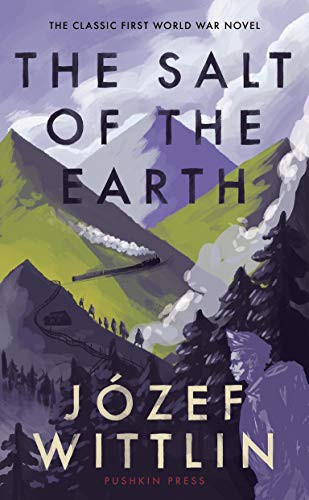
Stephanie Jane recenzis The Salt of the Earth de Jozef Wittlin
A fascinating novel
4 steloj
The story behind the creation of Salt Of The Earth is as poignant as the book itself. Originally written as a trilogy, all but a fragment of the second and all of the third volume were lost when, in France in 1940, a soldier hurled Wittlin's suitcase into the sea. He never re-wrote the novels. What remains of Piotr's story is a wonderful portrayal of Polish life just over a century ago. Salt Of The Earth is set at the very beginning of the First World War, when Wittlin himself would have been not much younger than Piotr, and was was written in the 1930s so I am confident that much of the fine, everyday detail is accurate and a record of a now-vanished way of life.
I loved Wittlin's rich poetic prose and Patrick Corness has done a superb job of rendering this in English. Piotr's Hutsul home is …
The story behind the creation of Salt Of The Earth is as poignant as the book itself. Originally written as a trilogy, all but a fragment of the second and all of the third volume were lost when, in France in 1940, a soldier hurled Wittlin's suitcase into the sea. He never re-wrote the novels. What remains of Piotr's story is a wonderful portrayal of Polish life just over a century ago. Salt Of The Earth is set at the very beginning of the First World War, when Wittlin himself would have been not much younger than Piotr, and was was written in the 1930s so I am confident that much of the fine, everyday detail is accurate and a record of a now-vanished way of life.
I loved Wittlin's rich poetic prose and Patrick Corness has done a superb job of rendering this in English. Piotr's Hutsul home is beautifully portrayed and I felt that we are given a great sense of how this uneducated socially isolated man lived. Ideas such as Piotr's deliberate shunning of the Devil's Signs (ordinary writing) were incredible to me as I often forget that not everybody has or, even so recently (historically speaking), had the same access to education. Piotr and his peers choose to hide their illiteracy behind superstition rather than allow the priest to teach them letters.
Wittlin follows Piotr though his unexpected promotion to signalman as a result of trained railwaymen being called up to war service, to Piotr receiving his own infantry uniform several months later in a barracks hundreds of miles from his home. All through this time Piotr has only a limited grasp of what the war is about in national terms or even how it is likely to affect him personally. His trust in his beloved Emperor is absolute therefore whatever the Emperor has ordered must be right. Such blind obedience - before any military training - was also a concept I didn't find it easy to empathise with although Wittlin's writing is utterly convincing and I never doubted Piotr's faith.
Salt Of The Earth is a very differently styled novel to my more usually modern reads. Partly I think this is due to its having been written over eighty years ago, but I was also always aware that its author came from another culture, somewhere with different ideas about what makes for a good life and a life well lived. As such, I found Salt Of The Earth a fascinating novel and I wish the trilogy's second and third volumes could have survived.